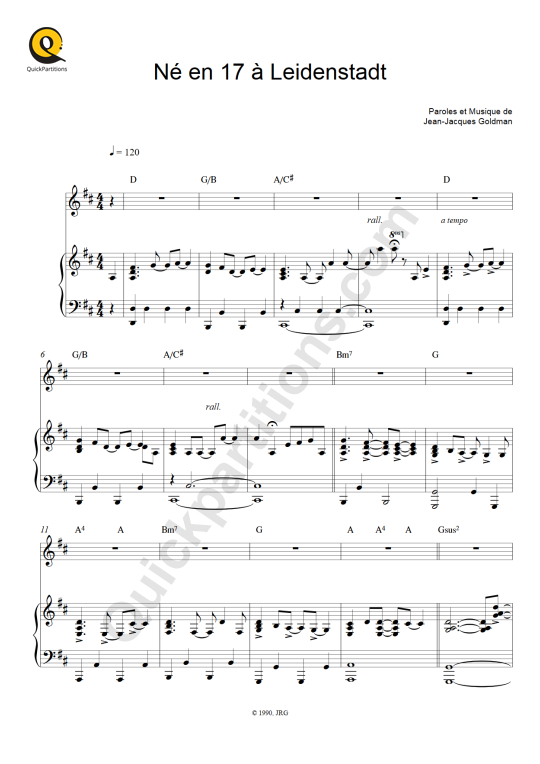
Jean-Jacques Goldman's 'Né En 17 À Leidenstadt': A Timeless Reflection on Morality and Identity
Few songs possess the enduring power to challenge, provoke, and resonate across generations quite like Jean-Jacques Goldman's masterpiece,
'Né En 17 À Leidenstadt'. This iconic track, famously performed by Fredericks, Goldman, and Jones, transcends its musical genre to become a profound philosophical inquiry into human nature, choices, and the immense influence of circumstance. As we delve into the profound questions posed by its
Paroles Né En 17 À Leidenstadt, we uncover a timeless exploration of what truly lies beneath our veneers when faced with extreme societal pressures and historical injustices.
Goldman, a legendary figure in French music, crafted lyrics that compel listeners to look inward, prompting a crucial self-assessment: "Aurais-je été meilleur ou pire que ces gens?" – "Would I have been better or worse than those people?" This deceptively simple question forms the backbone of a complex moral challenge, asking us to confront our potential for both heroism and complicity. The song’s universal appeal lies in its ability to transport us to various historical flashpoints, forcing us to imagine ourselves in impossible situations and consider the choices we might make.
The Poignant Question at the Heart of 'Né En 17 À Leidenstadt'
The central premise of
'Né En 17 À Leidenstadt' immediately plunges us into a vivid, harrowing hypothetical:
"Et si j'étais né en 17 à Leidenstadt
Sur les ruines d'un champ de bataille
Aurais-je été meilleur ou pire que ces gens
Si j'avais été allemand?"
Leidenstadt, a symbolic "City of Suffering," evokes a post-World War I Germany, a nation grappling with immense humiliation, economic hardship, and a brewing desire for revenge. Born in 1917, a child would have grown up amidst the seeds of World War II, "Bercé d'humiliation, de haine et d'ignorance / Nourri de rêves de revanche" – cradled in humiliation, hatred, and ignorance, nourished by dreams of revenge.
This stanza forces us to consider the powerful role environment plays in shaping our moral compass. Would an individual, steeped in such an atmosphere, possess the rare strength to become one of those "improbables consciences / Larmes au milieu d'un torrent" – improbable consciences, tears in the midst of a torrent? This imagery beautifully captures the immense difficulty, almost impossibility, of standing against the prevailing tide of collective emotion, particularly when fueled by historical grievances. It's a testament to the song's depth that it doesn't just ask about right and wrong, but about the sheer human capacity to *perceive* right and wrong in a context designed to obscure it. The
Paroles Né En 17 À Leidenstadt here ask us to confront the uncomfortable truth that our virtue might be more a product of our fortunate circumstances than inherent righteousness. For a deeper dive into these moral dilemmas, explore
Leidenstadt Lyrics: Exploring Morality and Destiny in Goldman's Work.
Navigating Divisive Landscapes: Belfast and Johannesburg's Moral Quandaries
Goldman masterfully extends this thought experiment to other globally recognized arenas of conflict, highlighting the universal nature of moral struggle.
Belfast's Faith and Caste: The Courage to Betray
"Si j'avais grandi dans les docklands de Belfast
Soldat d'une foi, d'une caste
Aurais-je eu la force envers et contre les miens
De trahir: tendre une main"
The reference to the "docklands of Belfast" immediately conjures images of the Troubles, the sectarian conflict in Northern Ireland where identity, religion, and community loyalties were inextricably linked. Growing up as a "soldier of a faith, of a caste," one would be immersed in a deeply divided society, where allegiances were not merely suggestions but often matters of life and death.
The question posed here is perhaps even more challenging: "Would I have had the strength against my own / To betray: to extend a hand?" This isn't just about resisting an external oppressor, but about challenging the very fabric of one's own community, family, and identity. "Betrayal" in this context is not a vice but a virtue – the act of reaching across a divide, defying ingrained hatreds, and seeking reconciliation. This requires an almost superhuman moral fortitude, a willingness to risk ostracism, danger, and the agony of going "against one's own." It forces listeners to ponder whether their personal convictions could ever outweigh the profound pressure of tribal loyalty.
Johannesburg's Power and Fear: Hearing the Cries
"Si j'étais née blanche et riche à Johannesburg
Entre le pouvoir et la peur
Aurais-je entendu ces cris portés par le vent
Rien ne sera comme avant"
The final specific scenario transports us to apartheid-era Johannesburg, a society starkly divided by race and class. Here, the perspective shifts to one of privilege – being born "white and rich." Such a position offered comfort and power, but also placed one "between power and fear" – the power of the ruling class and the underlying fear of retribution from the oppressed.
The question here is more subtle, yet equally profound: "Would I have heard those cries carried by the wind / Nothing will ever be the same?" This addresses the phenomenon of willful ignorance, the ability of those in power or privilege to tune out the suffering of others, to rationalize injustice, or simply to not perceive it. It's about empathy, awareness, and the moral awakening required to acknowledge systemic inequality. To "hear the cries" means to break through the comfortable bubble of privilege, to challenge the status quo, and to recognize the inevitability of change. It asks whether personal comfort would blind us to injustice, or if our conscience would compel us to confront uncomfortable truths. These poignant 'what if' scenarios are further explored in
What If? Leidenstadt's Powerful Questions on Choices and Identity.
Unveiling the Inner Self: Brave, Accomplice, or Executioner?
Beyond these specific historical contexts, the
Paroles Né En 17 À Leidenstadt culminate in a universal reflection on the true nature of the self:
"On saura jamais c'qu'on a vraiment dans nos ventres
Caché derrière nos apparences
L'âme d'un brave ou d'un complice ou d'un bourreau?
Ou le pire ou plus beau?"
This section is the philosophical core of the song. It acknowledges the inherent uncertainty of human character until tested. We can never truly know what lies deep within us, "hidden behind our appearances." Are we brave? Are we complicit? Or are we, disturbingly, capable of becoming an executioner? This introspection challenges our self-perceptions, forcing us to admit that our moral fiber is not a fixed entity but something revealed and forged in times of crisis.
The lyrics continue: "Serions-nous de ceux qui résistent ou bien les moutons d'un troupeau / S'il fallait plus que des mots?" – "Would we be among those who resist, or merely sheep in a flock / If it took more than words?" This sharpens the question, moving beyond passive observation to active engagement. It distinguishes between theoretical ideals and the painful reality of putting those ideals into practice when significant personal cost is involved. It’s easy to declare oneself a resister in times of peace, but much harder to be one when it truly matters.
Ultimately, the song concludes with a plea for grace: "Et qu'on nous épargne à toi et moi si possible très longtemps / D'avoir à choisir un camp" – "And may you and I be spared, if possible for a very long time / From having to choose a side." This is not a plea for apathy, but for the avoidance of situations where such terrible choices are necessary. It's an aspiration for peace and understanding that renders extreme moral tests obsolete, allowing human dignity to flourish without the shadow of forced complicity or heroic sacrifice.
Why 'Né En 17 À Leidenstadt' Remains Relevant Today
The enduring relevance of
'Né En 17 À Leidenstadt' stems from its timeless exploration of identity, empathy, and moral responsibility. In a world increasingly marked by polarization, conflict, and social injustice, the song’s message resonates as strongly as ever.
*
Encouraging Empathy: By placing listeners in the shoes of others, particularly those in challenging historical contexts, the song fosters a deep sense of empathy. It urges us to look beyond simplistic judgments and consider the complex interplay of environment, history, and individual choice.
*
Promoting Critical Self-Reflection: It's a powerful tool for personal introspection, prompting us to examine our own potential biases, privileges, and the foundations of our moral beliefs. Would we succumb to groupthink, or would we find the courage to stand apart?
*
Timeless Warning: The song serves as a constant reminder that the conditions that lead to division and injustice can re-emerge in different forms. It cautions against complacency and encourages vigilance in upholding democratic values, human rights, and peaceful dialogue.
*
Actionable Insight: While the song expresses a desire to avoid choosing a side, it implicitly challenges us to prepare for such moments by cultivating strong ethical frameworks, fostering critical thinking, and actively seeking to understand diverse perspectives *before* crises strike.
Jean-Jacques Goldman’s ability to weave profound philosophical questions into such evocative and accessible music is a testament to his artistry. The
Paroles Né En 17 À Leidenstadt don't offer easy answers, but they guide us towards a more honest and compassionate understanding of ourselves and our shared human experience.
Conclusion
Jean-Jacques Goldman's
'Né En 17 À Leidenstadt' is far more than just a song; it's a profound cultural artifact that invites deep introspection and moral contemplation. Through its vivid hypothetical scenarios – from a war-torn Germany to divided Belfast and apartheid Johannesburg – the song challenges us to confront the uncomfortable truth about our potential for both good and evil, deeply influenced by the circumstances of our birth and environment. The enduring resonance of the
Paroles Né En 17 À Leidenstadt lies in their universal call for empathy, self-awareness, and a fervent hope that we, as humanity, can cultivate a world where the agonizing choice of "which side to choose" becomes a relic of the past, rather than a recurring nightmare. It encourages us to look inward, understand the forces that shape us, and aspire to a future built on understanding, not division.